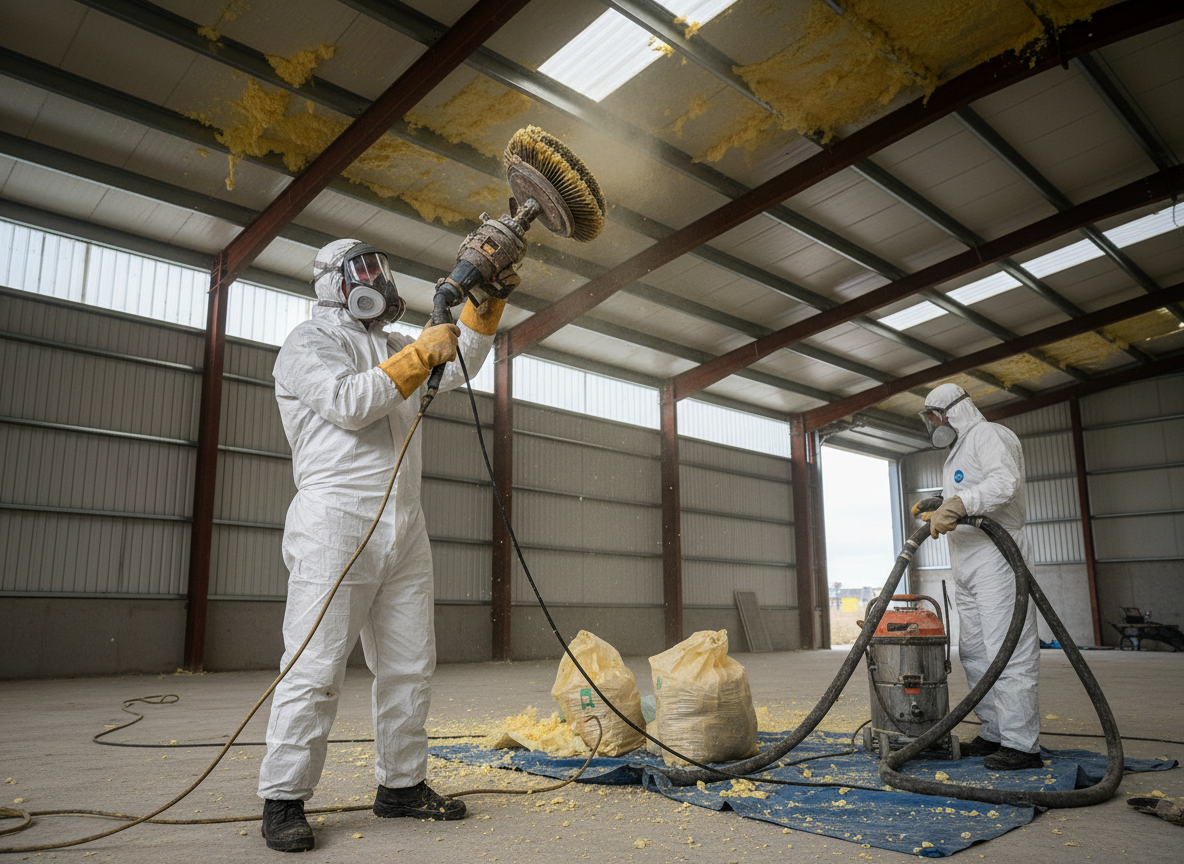
Hull's commercial stock includes many 1960s-1980s warehouses and light-industrial units around the docks and along Hessle Road where closed-cell foam was sprayed directly onto corrugated metal and concrete. Over time the foam absorbs moisture from the region's frequent driving rain and high humidity, trapping it against the substrate and causing hidden corrosion. Removing it requires negative-air containment and solvent-free scraping to avoid releasing particulates into adjacent occupied spaces or neighbouring units.
Edge cases we see regularly involve foam applied over asbestos-containing roof panels or electrical trunking in older Boothferry Road and Priory Road estates. These installations demand phased removal with daily air monitoring and full encapsulation of waste before transport to licensed disposal sites. Attempting DIY or using high-pressure water in these buildings risks breaching the foam into HVAC systems that serve multiple tenancies.
Local planning rules in Hull require notification for any work that disturbs insulation in buildings over 500 square metres. We coordinate with the council's environmental health team and provide a full waste manifest on completion. Winter work adds another layer because temperatures below five degrees slow curing of replacement coatings, so we schedule internal removal first then return for external sealing once conditions improve.
Seasonal Considerations
Hull's wet winters and salt-laden air accelerate foam breakdown on exposed commercial roofs. Scheduling removal between March and October reduces moisture-related delays and allows proper drying of substrates before new coatings are applied.
Technician insight
In Hull the thing that catches most people out with Commercial Spray Foam Removal is the older dockside warehouses where foam was sprayed straight onto single-skin metal that has already started rusting underneath. Once you start pulling the foam you find the corrosion has spread into the purlins and you have to stop and treat the steel before the job can finish.
Hessle Road Warehouse Foam Extraction
A storage unit on Hessle Road had closed-cell foam delaminating from the roof deck after years of condensation. We found water trapped behind the foam along the north elevation. The crew set up full containment, removed the foam in sections, treated the corroded steel and supplied the council with the waste manifest. The tenant was able to reopen without any disruption to adjacent units.
How it works
- 1
Site Survey and Containment Planning
We inspect the commercial property, identify foam type and substrate condition, then set up sealed negative-air zones to protect neighbouring units.
- 2
Mechanical and Chemical Removal
Foam is cut and scraped in controlled sections using solvent-free methods, with continuous air monitoring around Hull's older industrial buildings.
- 3
Substrate Cleaning and Waste Removal
Remaining residue is neutralised, surfaces are cleaned, and all waste is bagged and manifested for licensed disposal.
- 4
Final Inspection and Documentation
We photograph the cleared areas, provide the waste manifest and advise on any follow-up coating work required by local regulations.
Pricing
Cost depends on building size, foam depth, access restrictions and waste volume. We provide a written scope after the survey.