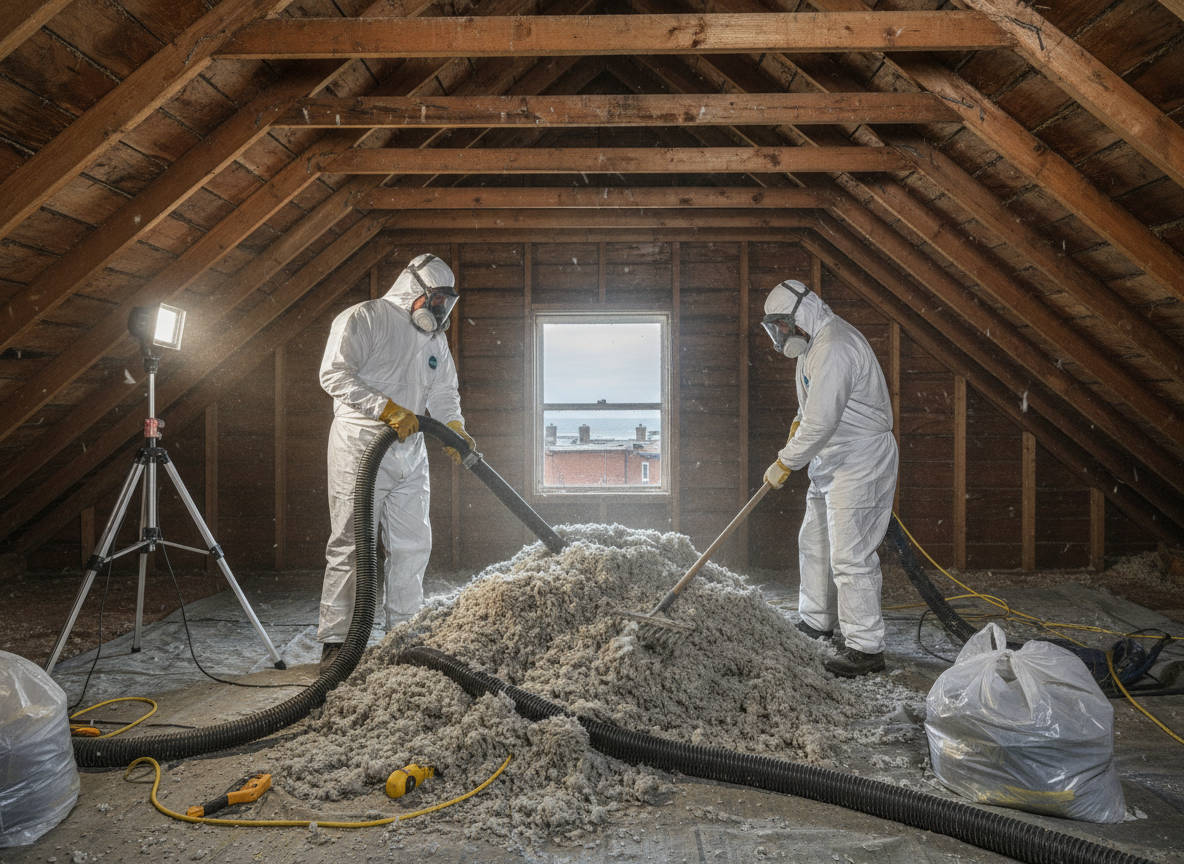
Hull's older terraced housing stock, particularly properties built before the 1950s along routes like Boothferry Road, often contains closed-cell spray foam applied directly to brick or lath ceilings and walls. Removing this material demands careful mechanical scraping and vacuum extraction because the foam bonds tightly to porous surfaces common in these homes, and any remaining residue can trap moisture from the region's frequent rainfall and high humidity.
Edge cases arise when foam has been installed over existing insulation or in lofts with limited access hatches typical of Hull's Victorian terraces. In these situations technicians must dismantle sections of ceiling or use flexible extraction tools to reach cavities without disturbing electrical wiring or pipework that runs through many of these older builds. Failure to address hidden pockets leaves behind material that can degrade and release particles into living spaces.
Local building practices in the Hull area mean many roofs have shallow pitches and minimal ventilation, which accelerates foam breakdown when water ingress occurs during winter storms. Removal crews therefore start by isolating the work zone with plastic sheeting and negative air machines to prevent dust migration into adjacent rooms, a step that becomes essential in closely packed streets where properties share walls.
After extraction the substrate is inspected for damp or rot, conditions that appear regularly in Hull's flat, low-lying terrain where groundwater sits close to foundations. Any affected timber is flagged for the homeowner before the space is left ready for new insulation or repair work.
Technician insight
In Hull, the thing that catches most people out with insulation removal service is how the damp clay soil and frequent rain keep older Boothferry Road terraces persistently moist, so the foam grips the brick far harder than expected and pulls plaster or pointing away if you rush the scrape.
Loft Foam in a Hull Terrace
Homeowner noticed musty smells and poor loft ventilation in a pre-war terraced house off Boothferry Road. We found closed-cell foam covering rafters and trapping condensation against the original lath. Extraction required sectional ceiling access and careful vacuum work to avoid disturbing shared chimney stacks. After removal the loft dried out and the owner could install proper ventilation without further issues.
How it works
- 1
Site Assessment
Technicians inspect the property in Hull to map foam locations, check for hidden cavities, and note access constraints typical of local terraced homes.
- 2
Containment Setup
Full plastic sheeting and negative air filtration are installed to contain dust and protect adjacent rooms common in closely built Hull streets.
- 3
Foam Extraction
Mechanical removal combined with HEPA vacuuming clears foam from ceilings, walls, and lofts while avoiding damage to original brick or lath surfaces.
- 4
Final Inspection and Cleanup
The team checks for residue, addresses any moisture issues found, and removes all debris before handing the space back to the owner.
Pricing
Upfront quotes based on property size, foam depth, and access difficulty; no hidden charges once work begins.