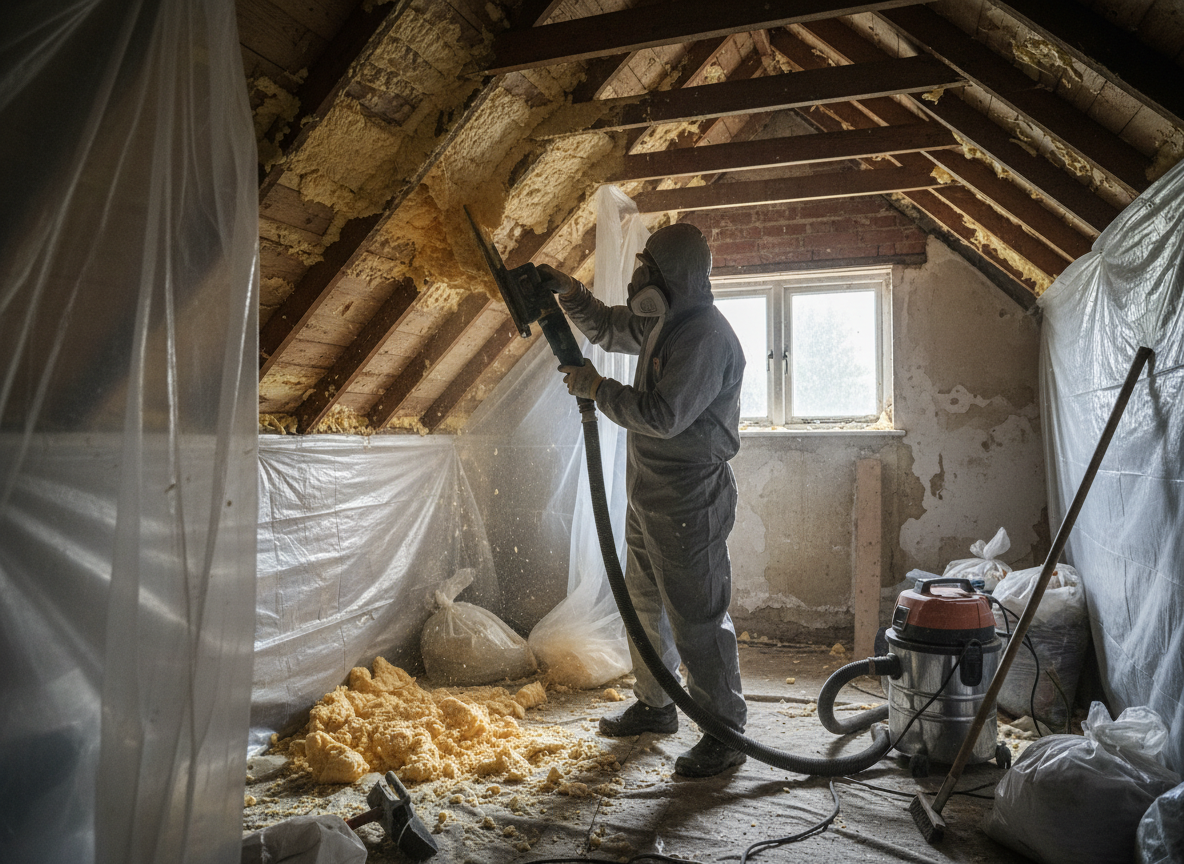
Hull's older terraced housing stock around Boothferry Road and the A63 corridor often features closed cell spray foam applied directly to rafters in the 2000s and 2010s. Mortgage lenders now flag these installations because they trap moisture against timber and block ridge ventilation, especially in properties exposed to Humber estuary humidity. Removal requires careful mechanical scraping and vacuum extraction to avoid damaging original lathe and plaster ceilings below while restoring airflow paths demanded by surveyors.
Winter weather in East Yorkshire accelerates the issues lenders notice. Once temperatures drop and condensation forms under the foam, rot develops faster in unventilated roof spaces common to Victorian terraces near the city centre. Technicians must work around shared party walls and narrow access hatches typical of Hull's dense housing, using dust containment that prevents debris falling into occupied rooms below during multi-day jobs.
Building regulations in the Hull area require reinstatement of continuous ventilation after foam removal. This means fitting new eaves and ridge vents plus checking for any insulation compression that could affect thermal performance ratings on energy surveys. Homeowners in areas like Anlaby and Hessle frequently discover that partial removal leaves enough residue to fail the next mortgage valuation, requiring full clearance back to the original timber.
Technician insight
In Hull, the thing that catches most people out with mortgage lender spray foam removal is how quickly the Humber damp gets behind foam on north-facing roofs in terraces off Boothferry Road. Homeowners often think a quick scrape will pass survey, but the residual film still blocks airflow and fails the next valuation.
Hessle Road Terrace Mortgage Hold
A 1930s mid-terrace in Hessle had closed cell foam blocking all rafter ventilation. The lender survey flagged it immediately. We removed the foam over two days, fitted new ridge and eaves vents, and cleared every trace so the re-inspection passed without further conditions.
How it works
- 1
Initial Loft Survey
Assess foam type, depth, roof structure condition and any existing damp in properties across Hull and nearby villages.
- 2
Safe Material Extraction
Mechanically remove foam layer by layer with dust extraction and containment suited to terraced house layouts.
- 3
Ventilation Restoration
Install compliant eaves, ridge and soffit vents to meet current lender and building control standards.
- 4
Final Clearance And Report
Clean the space and supply documentation for the mortgage lender's surveyor.
Pricing
Upfront quotes after site visit; final cost depends on foam depth, access difficulty and ventilation work required.