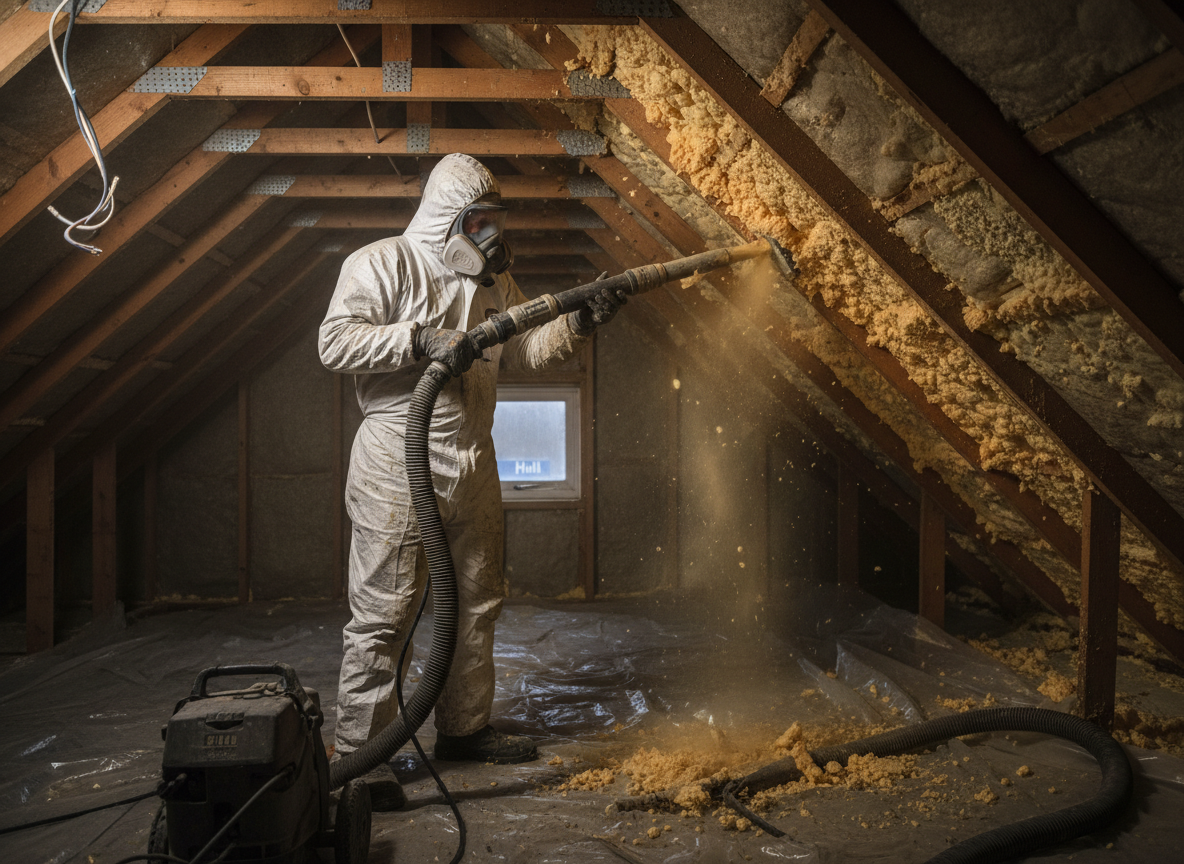
Thermal spray foam removal in Hull often involves older terraced houses built before 1930 with solid brick walls that trap moisture when closed-cell foam was applied directly to rafters. Crews must cut through multiple layers without damaging timber joists common in these properties near the Humber estuary, where salt air accelerates corrosion on metal fixings. Proper negative air machines and HEPA filtration prevent loose particles from settling into neighbouring homes during extraction.
Hull's frequent rainfall and high humidity mean foam bonds more aggressively to substrates, requiring heated blades or solvent softening in attics and under floors. Technicians check for hidden electrical cables and pipework typical in Edwardian and post-war builds before starting, then bag all waste for licensed disposal to meet local environmental rules. Incomplete removal leaves residue that can cause condensation problems in the next heating season.
Access challenges appear in narrow ginnels behind Boothferry Road terraces where equipment must be carried by hand. After stripping, surfaces are cleaned and ventilated to restore breathability in homes that originally relied on natural airflow rather than modern sealed insulation. Homeowners should inspect for timber rot once foam is gone, especially in properties close to the A63 corridor where ground moisture migrates upward.
Seasonal timing matters because winter work in unheated lofts demands extra lighting and temporary heating to keep tools effective, while summer jobs contend with higher dust levels that require additional containment sheeting.
Technician insight
In Hull, the thing that catches most people out with thermal spray foam removal is how quickly closed-cell foam bonds to the damp brick in pre-1930 terraces near the river, so you end up spending extra time softening edges or you risk pulling the pointing out with it.
Attic Removal in a HU5 Terrace
Homeowner noticed persistent condensation in a 1920s two-up two-down near Anlaby Road. Inspection found closed-cell foam trapping moisture against the rafters. Crew removed the foam layer by layer, cleaned the timber and restored ventilation. Condensation issues resolved after the work.
How it works
- 1
Site Assessment
Walk-through of attic or wall cavities to map foam thickness, substrate type and any hidden services in Hull properties.
- 2
Containment Setup
Install negative pressure zones and floor protection suited to narrow access in terraced homes around HU4 and HU5.
- 3
Foam Extraction
Use heated tools and manual cutting to separate foam from rafters and brickwork without structural damage.
- 4
Cleanup and Disposal
HEPA vacuum surfaces, remove all debris and transport waste to licensed facilities serving the Hull area.
- 5
Final Ventilation Check
Restore airflow and advise on follow-up inspections for moisture in older Yorkshire housing stock.
Pricing
Cost varies with access difficulty, foam depth and property age; NexaClean Crew provides upfront quotes after inspection.